
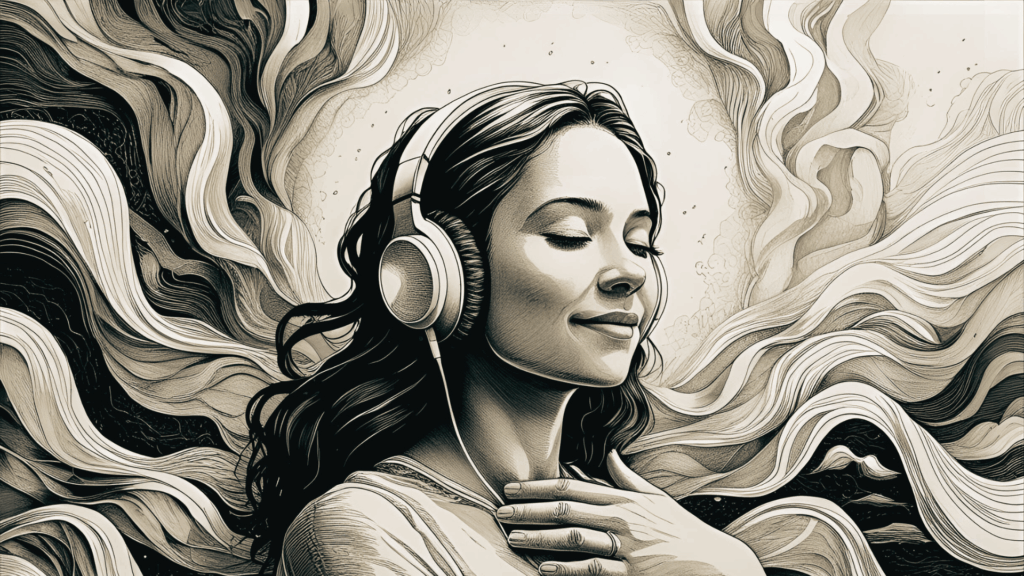

Expressive playlisting is a method for deepening your appreciation of music. It differs from other appreciation methods in that it’s not focused on becoming more educated about music per se. For example, it’s not about learning how to identify different kinds of rhythms or chord progressions so that you can notice these elements when you listen to music. Instead it’s about becoming more aware of music as you uniquely experience it. Put another way: expressive playlisting involves learning more about “music-for-you” vs. music in a more general, objective sense. It involves paying attention to the way your experience of music differs from those around you.
This can be surprisingly difficult, and I think there’s an unavoidable reason why this is so.
Losing Ourselves in “the They”
The psychologist Abraham Maslow said we have “impulse voices” that we can hear when we’re young but are progressively harder to notice as we age. This is our “inner voice” that tells us what we want and do not want.
In later childhood a different voice enters the picture—one that sociologists call the voice of the “generalized other.” We develop the ability to experience ourselves through the viewpoints, attitudes and expectations of others, and with this comes a powerful pressure to conform. As we pass out of childhood, it becomes harder to notice what we actually like, and easier to notice what we should like. Each time we act on the basis of this, we become a little more like those around us, and a little less like ourselves.
While this promotes social cohesion, it makes it harder to recognize how we, as unique individuals, actually think and feel about things. We lose touch with the world-for-me (the world as I actually experience it) as we become immersed in the world-in-general (the world as I think I should experience it) and our way of being becomes increasingly conventional in the process. That is, I increasingly override my experience of something in order to bring it in line with others’ experience of that same thing. If I like The Carpenters more than Radiohead, I keep it to myself. At a certain point, it becomes difficult to even recognize what I actually do like anymore.
Our unique responses to the things of the world—those personalized shades of feeling and meaning that attract or repel us when we encounter something—become hidden within these more conventional perceptions. They’re still there, but they recede into the background as we focus on something more salient: the common view of things that make it possible to fit in with those around us.
There’s a lot of social reinforcement for engaging with the world in the same way others do, and the real threat of punishment for those who don’t. As psychologists Efran and Clarfield put it:
“Situational categories emphasize commonality of response, so that people who respond a little differently tend to be pathologized…Living in a social community forces each of us, in varying degrees, to de-emphasize or disguise distinctive reactions to stock situations.“
-Jay Efran and Leslie Clarfield, Context
Without encouragement to pay attention to our distinctive reactions to the world, we can forget they’re even there. We can become so good at reading the room that we become incapable of hearing ourselves. Absorbed in the everyday mode of normative, socially-conditioned responses (how to dress, how to converse, what I should watch, what I should listen to, etc.), we lose touch with the highly specific way the things of the world speak to us.
We also lose touch with our unique way of doing things. One of the most striking examples of the distinction between the world-for-me and the world-in-general can be found in painter Georgia O’Keefe’s biography:
“One day in the middle of October, Georgia went into her studio, shut the door, and turned the key. She was still dissatisfied with her work, and she didn’t know why. She hung her most recent drawings and watercolors on the walls. Then she analyzed them with ruthless detachment: She noted which ones were painted to please one professor, and those to please another; she noticed which well-known artists had influenced other pictures. She sat, looked, and thought. Then an idea dawned on her. There were abstract shapes in her mind, integral to her imagination, unlike anything she had been taught. “This thing that is our own is so close to you, often you never realize it’s there,” she later explained. “I visualize things very clearly. I could think of a whole string of things I’d like to put down but I’d never thought of doing it because I’d never seen anything like it.” Although she didn’t know exactly how she would express these “things,” it suddenly seemed very simple. She made up her mind: This was what she would paint.”
-Laurie Lisle, Portrait of an Artist: A Biography of Georgia O’Keefe, p.96
Reversing this Process
Expressive playlisting is an invitation to do exactly what O’Keefe describes above, but with music listening.
It reverses the process of immersion in the viewpoint of the other by redirecting attention back to your own lived, here-and-now experience of music. It awakens you to this subtle dimension of music as it uniquely strikes you. It’s a practice for training your ability to hear Maslow’s “impulse voices” in the domain of music and reclaim a sensitivity lost, for many of us, as we passed out of childhood.
It’s also a practice of bringing something into the world. You’re developing a new way of listening, in the form of the personal microgenres you uncover in the process. Like O’Keefe’s “whole string of things I’d like to put down but I’d never thought of doing it because I’d never seen anything like it,” you have things you’re uniquely able to appreciate in music that have not yet been brought forth by others as “things to listen for.” You get to make this discovery for yourself. You get to bring it into the world.
As mentioned earlier in this post, the elements explored in this form of music appreciation will not be the already identified components of music theory (like scales and intervals). They will not be existing genres like “dream pop” or “jangle pop.” The elements will be novel, emergent and thoroughly personal. They are the emotionally-charged motifs or patterns that arise for you when you encounter music; the qualities that stand out for you in particular as you listen.
These qualities do not already exist as things you can orient to like the song’s tempo or time signature, because they arise in the union of you and a particular song. They are personal and preverbal, which means they are not already part of the cultural stock of knowledge that we all draw on to make sense of our experience. These aspects show up, while listening, as flickers of feeling that beckon you in particular. You get to be the one to discover them and name them into being.
Once you’ve done so, they become easier to notice. You can rely on these emerging, personalized constructs to orient you as a listener rather than only relying on the common ones of music theory. You learn how to listen to music from yourself in some sense. You learn how to listen in your own unique way, for that which is personally evocative for you. And because these personalized constructs tend to cut across existing genres, this can dramatically increase the range of music you’re able to enjoy.
Let me give you an example of what I mean.
My Experience with Hip-Hop Music
I’ve wandered deeper into hip-hop over the past couple years. With repeated listening, my experience of this music is becoming more differentiated. But the differentiation has not been along conventional lines. I have not relied on existing sub-genre frameworks like boom-bap, grime, trap, drill, etc., to organize my experience of the music.
I also haven’t relied on regional distinctions (e.g., distinguishing southern rap from west-coast rap), or the music theory around beat construction and rhyme schemes to organize my experience of rap.
I’ve allowed that which speaks to me in rap to come into being through the process of pull-following and then I’ve given it a firmer, more objective formulation by distinguishing & naming it (i.e., creating a playlist around it). This process externalizes it. It makes it a thing to listen for, like genre, region or type of beat, but unique in that it’s a thing that grew out of my experiencing of the music.
I’ve learned how to listen for that which I specifically respond to in rap music. You can do the same with any genre and it might be really interesting to discover what categories emerge spontaneously for you in this process, and what they illuminate about your style as a listener.
In my own case, here are some “personal microgenres” that have grown out of my experience of rap music and that I’ve learned to recognize:
- Jut: rap music with a herky-jerky groove that makes you feel pulled in two different directions at once
- Rollin’: rap music with a groove that rolls over you; the rapper’s flow plays off of this relentless, forward momentum in a “push and pull” kind of way
- Rapt: rap music with a strong contrast between stark, hard beats and the intricate flows that weave around them. This has a mesmerizing effect on me, hence the playlist name.
These are three elements I listen for in rap music. They’ve become differentiated out over the course of a couple years. They are as much about me as the music, because they represent what seizes me when I listen to hip-hop. But they’re not entirely subjective–my hope is that you could hear the difference between these qualities if you listened for them. In any case, these are frameworks for orienting to and appreciating music, much like genre and music theory concepts, but they are frameworks that have grown organically out of my own experience of the music. They help me better hear what my soul is uniquely drawn to in music.
Brought in at this point, music theory can be revelatory because it helps you make technical sense of what you’ve discovered you respond to through this prior process of feeling. Far from being an arbitrary exercise in classification (“this is a triad, this is a seventh chord”), music theory now extends the self-discovery process by enriching your understanding of music-for-you.
An Invitation to You
You can do this too.
Have you ever wondered about the specific qualities you are most drawn to in music? Perhaps you don’t have words for the quality yet, but you can point to this song, this song, and that song, that all seem to have it.
Have you ever thought of giving this quality a name?
It is something, right? There’s something there you’re responding to, and until it’s put into words, it will remain hard to pin down or even notice.
When you start building a playlist around it, you’ll further incarnate this subtle quality your soul is drawn to. You’ll start noticing more and more songs that have it. After a while, it will come to function like a genre in that it will organize your experience of music. But unlike other genres, this category is an expression of you. This process transforms music listening by adding a dimension of self discovery to it.
Concepts help us penetrate deeper into reality. The concepts of a botanist enable them to see deeper into the world of plants than the average person, and to notice phenomena the rest of us miss. The clinical concepts of a doctor do the same thing with physical symptoms or the ambiguous shapes on an x-ray. Expressive playlisting helps you develop your own concepts, which enable you to move deeper into the world of music-for-you. It improves your ability to perceive what your soul is drawn to in the domain of music. It makes this visible, so that it can be noticed and engaged with more intentionally. Your library of playlists become a tangible expression of your essential style as a listener, while at the same time awakening others to qualities in music that have been overlooked.
You might discover that the qualities you’re drawn to in music show up in other areas of your life, almost like “personal motifs.” For example, these patterns may show up in what you respond to in clothing styles, personality types, art movements, literary styles, and geographic locales. It can be a striking self-discovery to notice this hidden unity in your experience. Here playlist curation pushes beyond music enjoyment to a practice of self-realization as the making of playlists becomes a way to bring your essential style more fully into the world, making it more recognizable to you and to others.
If you try this out and want to share what you’ve done, please post the link to your playlist below. I’d love to hear what you’re discovering.
Last Updated on April 27, 2026
